Guides
What Happens to Your Crypto When You Die?
Crypto doesn't disappear when you die, and it doesn't pass to your family on its own. What happens depends on where it's held and whether anyone knows it exists. Here are the three possible outcomes and how to make sure yours is the good one.
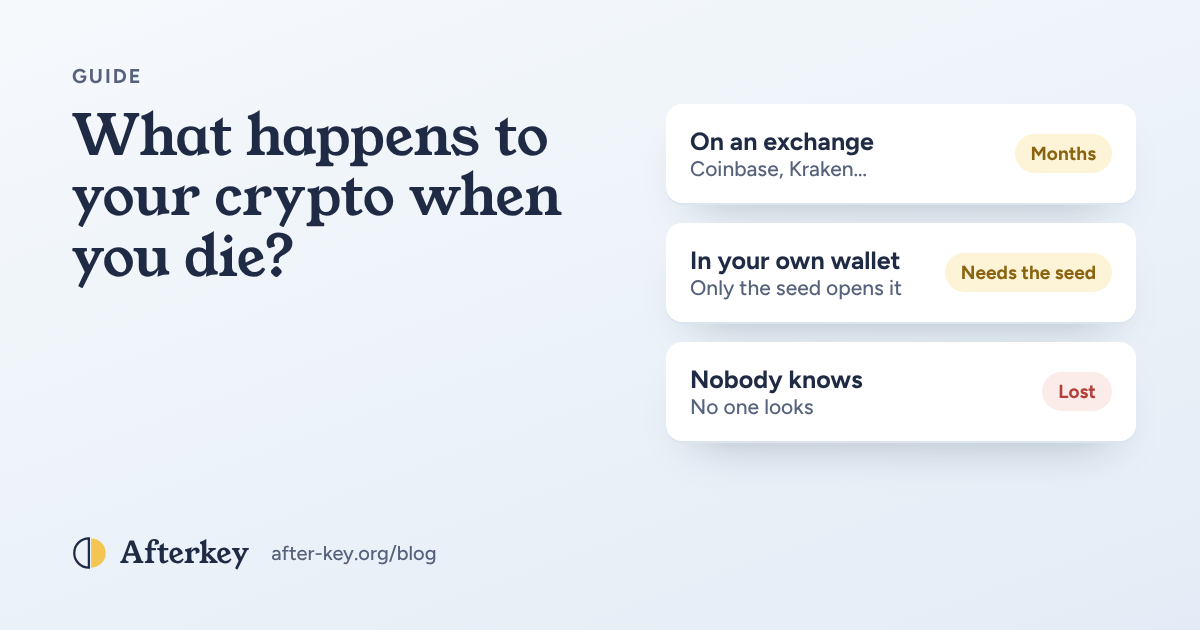
Short answer: nothing happens automatically. Your crypto stays exactly where it is. Whether your family ever gets it depends on two things: where you hold it, and whether anyone knows how to reach it.
Legally, crypto is part of your estate like any other property. Practically, it behaves very differently from a bank account. There’s often no institution that can hand it over, no account statement arriving in the mail, and no customer service line for a seed phrase. That’s why so much of it is never recovered.
If your crypto is on an exchange
Coins held on an exchange such as Coinbase, Kraken or Gemini are in an account the exchange controls. That’s the most recoverable situation, but it’s rarely quick.
The estate has to prove two things: that you died, and that the person asking has legal authority over your estate. In practice that means a death certificate plus court documents, such as letters testamentary from a probate court or, for smaller estates, a small-estate affidavit. Large transfers can also require a medallion signature guarantee from a bank, according to Crypto Asset Recovery.
A few things families are surprised by:
- You usually can’t name a beneficiary. Unlike many bank and brokerage accounts, Coinbase has “no beneficiary designation, no transfer-on-death registration,” as Ryder summarizes it. The estate goes through a claims process instead, and the timeline is measured in months.
- Support can be slow. In one widely shared case from 2024, an executor spent about a month trying to access her late father’s Coinbase account, with escalations and dropped calls, and got through only after filing a complaint with the Better Business Bureau, as Fido Estate reported.
- Nobody can claim an account they don’t know about. The exchange won’t contact your family. If no one knows you had an account, or which email it was under, it simply sits there.
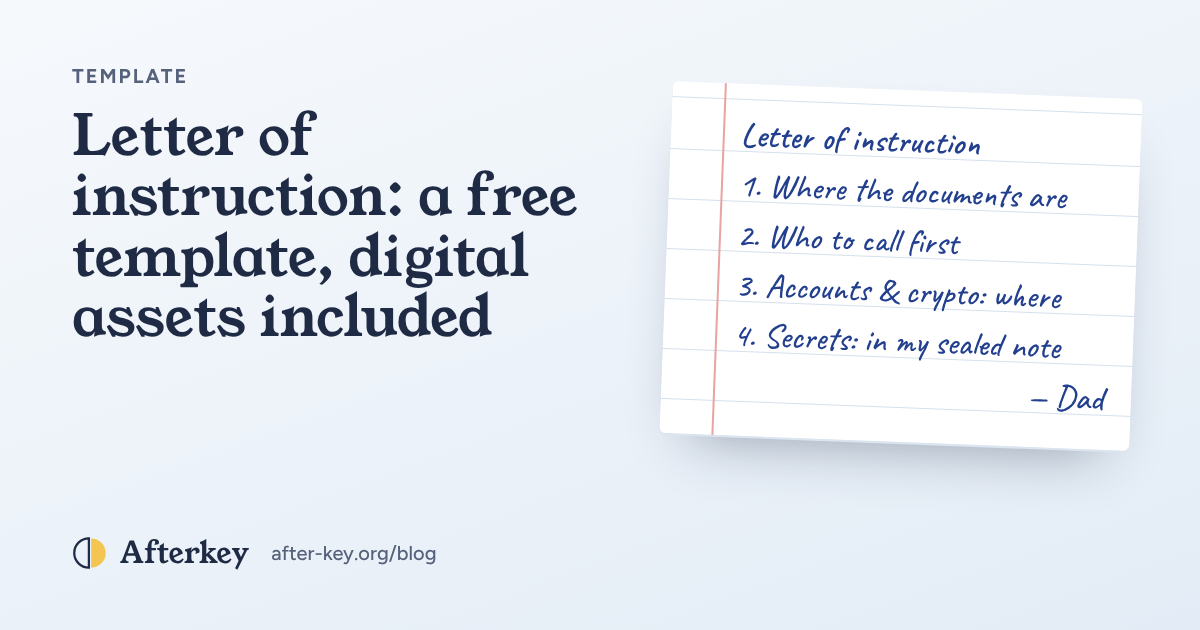
What helps: a list of every exchange you use and the email address on each account, kept where your executor will find it. A letter of instruction is the natural place for it.
If your crypto is in your own wallet
With a hardware wallet (Ledger, Trezor), a software wallet (MetaMask, Exodus) or a paper backup, there is no company in the middle. Whoever has the seed phrase, the 12 or 24 recovery words, controls the funds. Whoever doesn’t, doesn’t.
That gives your family two very different outcomes:
- The seed phrase is found. Your heir can restore the wallet and move the funds. So can anyone else who finds it first, which is why seed phrases shouldn’t sit in a drawer next to the will.
- The seed phrase is lost. The funds are gone for good. A court order can’t open the wallet, and neither can the wallet manufacturer. A hardware wallet without its PIN or backup is just a device.
This isn’t a rare edge case. The blockchain analytics firm Chainalysis estimated in 2017 that between 2.78 and 3.79 million bitcoins had already been lost, roughly 17–23% of all bitcoin in circulation at the time, as reported by Finance Magnates. Death is one of the ways coins get there.
If nobody knows your crypto exists
This is the most common failure and the quietest one. Surveys keep finding that crypto holders don’t tell anyone:
- In a 2024 survey of 1,000 US adults by All About Cookies, 63% of crypto holders had no digital will, and half of respondents had digital-asset accounts their partners didn’t know about, as DL News reported.
- A 2020 study of 1,150 crypto investors by the Cremation Institute found that 89% worried about what would happen to their crypto, yet only 7% used a will for it. Of those who had made some plan, 65% had simply left instructions somewhere around the house, according to Cointelegraph.
The trail also goes cold fast. Exchange accounts are usually tied to an email address, and email providers delete inactive accounts: Google after two years of inactivity, and Microsoft freezes accounts after one year and deletes them after two, per Crypto Asset Recovery. Once the inbox is gone, so are the welcome emails and statements that would have told your family where to look.
Does the law help your family get access?
Partly. Most US states have enacted, or are enacting, the Revised Uniform Fiduciary Access to Digital Assets Act (RUFADAA), a model law that lets executors and other fiduciaries manage a person’s digital assets, according to Nolo.
Under it, an executor can generally reach digital assets but may need to go to court and explain why each one is needed. Online companies can ask for court orders, limit access to what’s “reasonably necessary,” and fall back on their terms of service if you didn’t give explicit permission in your will, trust or power of attorney. Private email contents stay closed unless you consented.
What the law can’t do is produce a password or a seed phrase. RUFADAA can make an exchange cooperate with your executor. It can’t open a hardware wallet in a drawer.
What about taxes?
The IRS treats virtual currency as property for federal income tax purposes, according to its virtual currency FAQs. For inherited property, the IRS says the basis is generally the fair market value on the date of death. In plain terms: if your heir later sells, their taxable gain is usually measured from the price on the day you died, not from what you originally paid.
Very large estates may also owe federal estate tax, due whether or not the heirs can actually reach or sell the crypto. Rules change and every situation differs, so have your heirs talk to a tax professional before selling.
Two cases that show what goes wrong
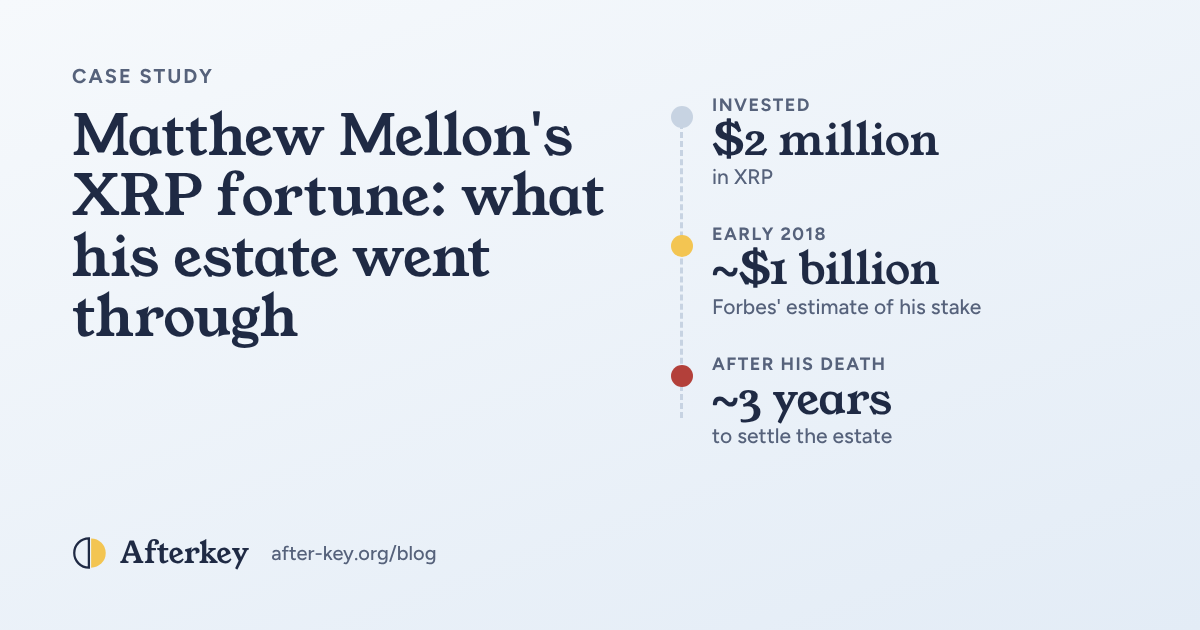
Matthew Mellon, 2018. The banking heir had turned an early XRP bet into a fortune Forbes valued at about $1 billion. When he died suddenly in April 2018, his keys were reportedly on devices held under other people’s names in different places. His estate needed almost three years, and unusual cooperation from Ripple, to work through it. Read the full story.
QuadrigaCX, 2018–2019. After the founder of the Canadian exchange died, the company said only he could access its cold wallets. Its roughly 115,000 customers were owed about $190 million. Investigators from Ernst & Young later found that most of those wallets had been emptied months before his death, The Register reported. The lesson for individuals: when one person holds every key and every secret, everyone else is exposed.
How to make sure your family can reach your crypto
- Write an inventory. Every exchange and the email it uses; every wallet and where its device and backup are kept. Locations, not secrets.
- Decide who should get access, and who should help. An heir, an executor, an attorney, or a mix.
- Make access survive you, without handing it over today. Giving someone your seed phrase now means they can move your funds now. Options range from a sealed envelope with your attorney to multisig setups and inheritance services. Afterkey splits the key between your heir’s printed card and a server half that’s released only after a waiting period you can cancel.
- Tell someone where the plan is. One conversation turns a perfect plan from useless into useful.
- Mention your digital assets in your will. Ask your estate attorney how to give your executor explicit permission to access them.
- Review it once a year. New wallet, new exchange, new phone: update the note.
FAQ
Is crypto lost when you die?
Not automatically. Crypto on an exchange can usually be claimed by your estate, slowly. Crypto in your own wallet can be recovered only if someone has the seed phrase. It’s effectively lost if nobody knows it exists or nobody can open the wallet.
Can Coinbase release crypto to my family?
Yes, to the person with legal authority over your estate, after it receives a death certificate and court documents. You generally can’t name a beneficiary on the account in advance.
Can my family recover a hardware wallet without the seed phrase?
Usually not. Without the seed phrase or the PIN, nobody, including the manufacturer, can open it. That’s the point of a hardware wallet, and it’s why the backup’s location needs to be written down somewhere your heir can find it.
Should I put my seed phrase in my will?
Generally no. A will can become public during probate, and anyone who reads the seed phrase can move the funds. Use the will to authorize access and a separate, sealed or encrypted document for the access details themselves.
Sources
- Crypto Asset Recovery: I had a death in my family. How do I recover their crypto?
- Ryder: Coinbase beneficiary, why you cannot name one
- Fido Estate: Coinbase hangs up on estate administrator
- Finance Magnates: Study finds almost 4 million bitcoins lost forever
- DL News: 63% of crypto holders don’t have a digital will
- Cointelegraph: 89% worry what happens to their crypto after they die
- Nolo: The Uniform Fiduciary Access to Digital Assets Act
- IRS: Frequently asked questions on virtual currency transactions
- IRS: Gifts & inheritances
- The Register: QuadrigaCX cold wallets empty
This guide is general information, not legal, tax or financial advice. Laws differ by state and country; talk to an estate planning attorney about your situation.