Templates
Letter of Instruction: Free Template (Including Your Digital Assets)
A letter of instruction tells your family where everything is and who to call. Here's what to put in it, what to keep out of it, and a free printable template with a section for crypto and online accounts.
Your will says who gets what. It almost never says where things are or how to get to them. That gap is what a letter of instruction fills: a plain, private document that walks your executor and family through your affairs, from the insurance policy in the filing cabinet to the exchange account they’ve never heard of.
This guide covers what a letter of instruction is, what to include, and the one section most templates get dangerously wrong: your digital assets. You can download the free template below and fill it in by hand tonight.
What is a letter of instruction?
A letter of instruction is an informal document that gives your executor and heirs the practical details they need after you die or if you become unable to manage your affairs. It can be typed or handwritten, and you don’t need a lawyer to write one, according to the Ohio State University Extension.
Three things make it different from a will:
- It is not legally binding. As the Ohio State factsheet puts it: “There is no legal requirement for a letter of instruction, and it is not legally binding.” Anything that must be enforced, such as who inherits what or who becomes guardian of your children, belongs in your will.
- It stays private. A will becomes a public document once it is admitted to probate court, as FindLaw notes. A letter of instruction isn’t filed with the court.
- It’s easy to update. You can change it whenever your accounts or wishes change, without going back to your attorney. It should never contradict your will, though: if the two disagree, the will wins.
Letter of instruction vs. will
The simplest way to think about it: three documents, three jobs.
| Will | Letter of instruction | Encrypted note | |
|---|---|---|---|
| Answers | Who gets what | Where things are, who to call | How to get in |
| Legally binding | Yes | No | No |
| Who can read it | A court, and often the public after probate | Anyone who finds it | Only your heir, and only when it’s needed |
| Needs a lawyer | Usually | No | No |
| Belongs in it | Heirs, executor, guardians | Accounts, documents, contacts, wishes | Where seed backups are, PIN hints, 2FA backup codes |
What to include in a letter of instruction
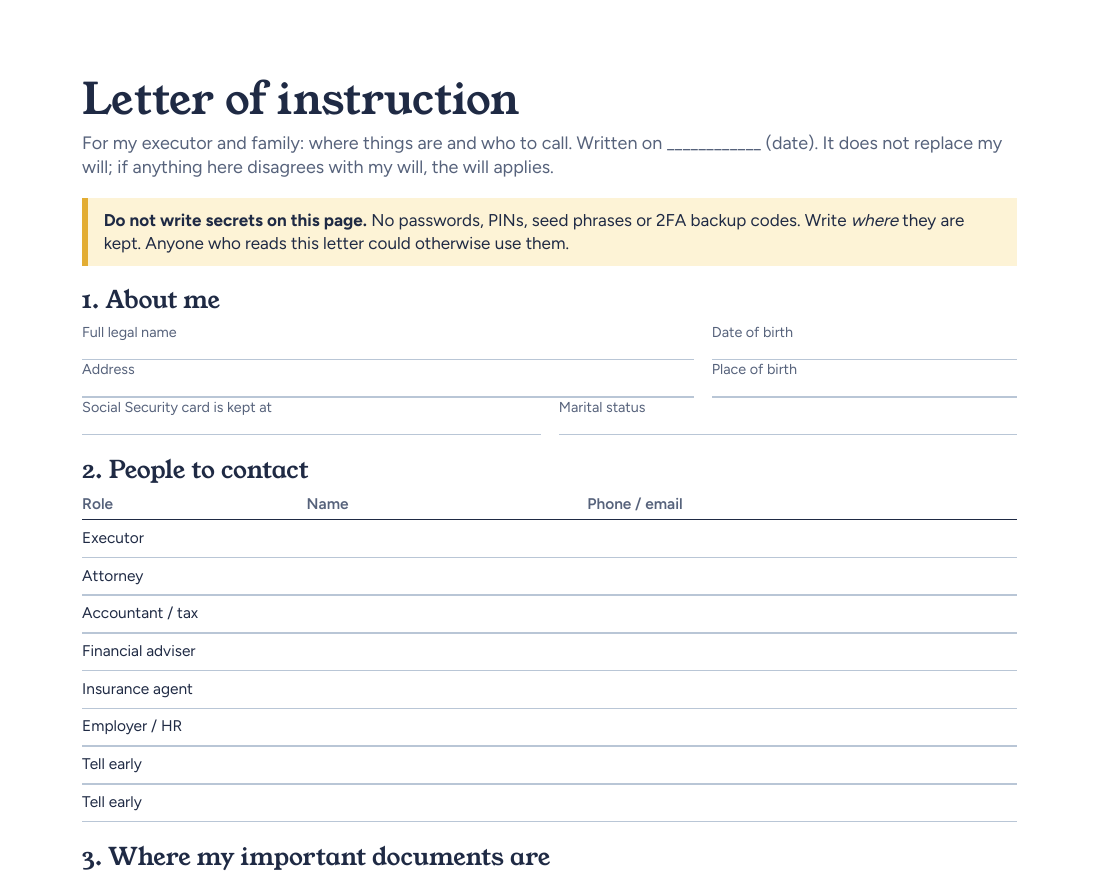
The template follows the sections that estate planners commonly recommend, plus a digital section built for how people actually live now. Fill in what applies to you and skip the rest.
- About you. Full legal name, date of birth, where you were born, Social Security number location (not the number itself), marital status.
- People to contact. Your executor, attorney, accountant, financial adviser, insurance agents, employer, and the friends and family who should hear the news early. Phone numbers and emails.
- Where your important documents are. Will and any trusts, birth and marriage certificates, deeds, car titles, tax returns, insurance policies, military discharge papers. Name the room, the drawer, the safe, or the attorney’s office.
- Money and accounts. Each bank, brokerage and retirement account: the institution, the type of account, and the last four digits of the account number. Not passwords.
- Insurance and benefits. Life, home, car and health policies, pensions and annuities, and who the named beneficiaries are.
- Debts and regular bills. Mortgage, loans, credit cards, subscriptions and anything paid automatically, so nothing lapses or keeps charging for years.
- Digital life and crypto. Covered in detail in the next section.
- Final wishes. Burial or cremation, a prepaid plan if you have one, organ donation, the kind of service you’d like.
- Personal property and messages. Who should get the watch or the recipe box, care for pets, and anything you want to say that doesn’t fit in a legal document.
The digital section most templates get wrong
Many letter of instruction templates simply tell you to list your online accounts and their passwords. FindLaw’s guide, for example, suggests listing “all online accounts, including social media accounts, and passwords for each.”
For a bank login that might be survivable. For crypto it’s a serious risk. A letter of instruction is a piece of paper that relatives, assistants, movers and estate staff may all handle. If it contains a seed phrase, anyone who reads it can move the funds, today, with no court and no waiting period. There is no bank to reverse it.
So the rule for the digital section is: write where things are, not what they are.
What to write in your letter
- Which crypto exists. “I hold bitcoin and ether. Some is on Coinbase, some on a Ledger hardware wallet.” Families can’t recover what they don’t know about.
- Exchanges and the email address each account uses. That email is how the estate will prove the account and correspond with the exchange.
- Hardware wallets: where the device is, and where its backup is kept. Not the PIN, and not the words.
- Who knows the rest. “The access details are in my encrypted note; my daughter has the card that opens it.” Or “my attorney holds a sealed envelope.”
- Your phone and email. Where the phone is, and whether you’ve set up the built-in legacy tools that let a trusted person into your phone or email account after you die.
- Password manager. Which one you use, and where its emergency kit or emergency access settings are documented.
What to keep out of it
- Seed phrases (the 12 or 24 recovery words)
- Private keys, wallet passwords and PINs
- Two-factor backup codes
- Passwords to your email or password manager
Those belong somewhere that stays sealed until it’s genuinely needed: a sealed envelope held by your attorney, a safe deposit box your executor can reach, or an encrypted note that only opens for your heir after a waiting period.
Where to keep your letter of instruction
A letter nobody can find is worthless. The Ohio State factsheet is blunt about it: “If your loved ones do not know of the existence or the location of your letter of instruction, the letter is useless.”
- Keep the original with your will, or wherever your executor will look first.
- Give a copy to your executor or your attorney. Mark the date on every copy so it’s clear which is current.
- Tell your family it exists and where it is. That one conversation matters more than any template.
- Don’t rely only on a safe deposit box. Depending on your state and bank, opening a deceased person’s box can take paperwork and time, which is exactly when your family needs the letter.
When to update it
Review it once a year and after any big change: a new account or exchange, a move, a marriage or divorce, a new child or grandchild, a new phone. Date every version and destroy the old ones, so there’s never a question about which letter is current.
How Afterkey fits in
Afterkey is the “encrypted note” in the table above. You write down where your crypto is and how to reach it; Afterkey encrypts the note in your browser before it’s saved, so we can’t read it. Your heir gets a printed card with half of the key. The other half opens only after a waiting period you choose, and you can cancel any request with one click if you’re still around.
Your letter of instruction then needs just one line for the hardest part: “How to access my crypto is in my Afterkey note. My heir card is with Sam.”
FAQ
Is a letter of instruction legally binding?
No. It guides your family and executor, but it can’t override your will or decide who inherits. Put anything that must be enforced in your will.
Do I need a lawyer to write a letter of instruction?
No. You can write it yourself, by hand or on a computer. Tell your attorney it exists so it doesn’t contradict your will.
Should I put passwords in a letter of instruction?
Not for anything that can move money, and never a crypto seed phrase. Write where the access details are kept, and keep the details themselves in a sealed or encrypted place.
What’s the difference between a letter of instruction and a letter of wishes?
The terms are often used interchangeably. In the US, “letter of instruction” usually means the practical guide described here. A “letter of wishes” more often accompanies a trust and guides the trustee.
Sources
This guide is general information, not legal, tax or financial advice. Laws differ by state and country; talk to an estate planning attorney about your situation.