Case studies
Matthew Mellon's XRP Fortune: What His Estate Went Through After He Died
The banking heir turned a $2 million XRP bet into a stake Forbes valued at $1 billion, then died suddenly with his keys spread across devices under other people's names. Here's what his estate went through, and what it means for anyone holding crypto.
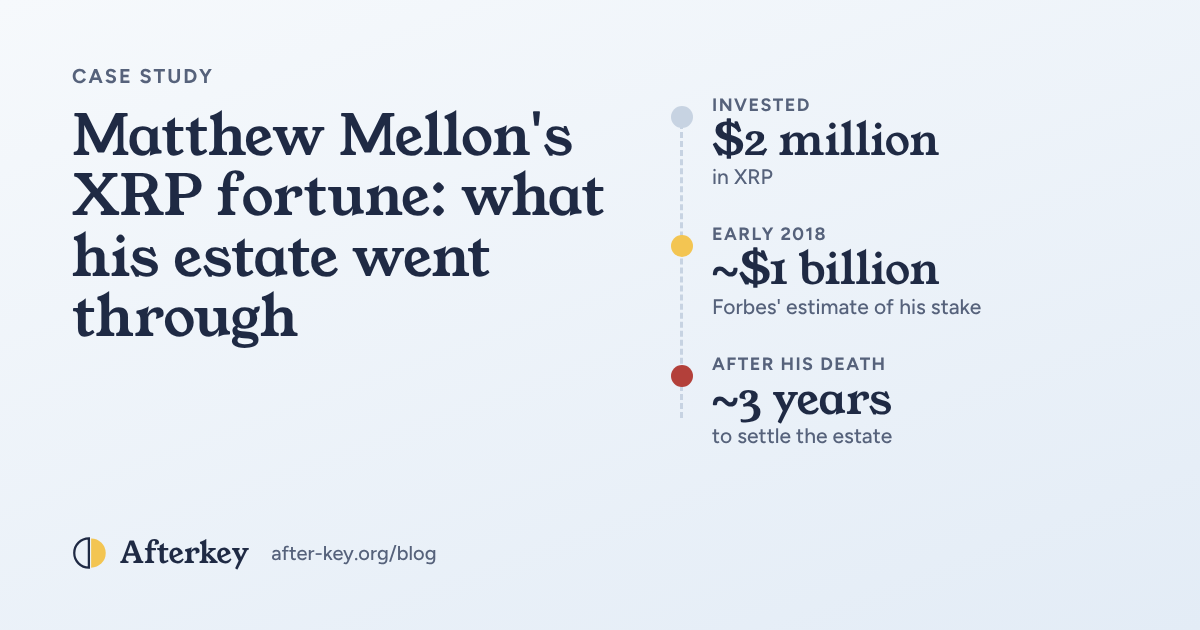
In early 2018, Matthew Mellon was one of the richest people in crypto. A roughly $2 million investment in XRP had turned into a stake Forbes valued at about $1 billion, according to Wikipedia’s summary of the Forbes report. A few months later he was dead, and his family’s lawyers were trying to work out how to reach a fortune stored on devices held under other people’s names.
The headlines at the time said the money was lost. It wasn’t, quite. What actually happened is more useful to know, because it shows how even a well-resourced estate can spend years untangling crypto that nobody else could open.
Who was Matthew Mellon?
Mellon was born in New York in 1964 into the Mellon banking family, descendants of the founder of Mellon Bank. He worked in fashion, founding the men’s shoe label Harry’s of London, and was married for several years to Tamara Mellon, a co-founder of Jimmy Choo, per Wikipedia.
In crypto he was an early, vocal believer in XRP, the digital asset associated with Ripple. He reportedly put about $2 million into it. When XRP peaked in January 2018, his stake was worth around $1 billion, which earned him a place on Forbes’ list of the richest people in cryptocurrency, as the Duke FinReg Blog noted.
He died suddenly on April 16, 2018, in Cancún, Mexico. He was 54.
How he stored his crypto
Mellon reportedly took security seriously, perhaps too seriously for anyone who came after him. According to the Daily Dot, which reviewed more than 700 pages of court documents, he kept the keys to his XRP “on devices under other people’s names in various locations throughout the country.” The Duke FinReg Blog described them as cold wallets, not connected to the internet, kept under pseudonyms in different locations across the US.
As protection against theft, that’s a strong setup. Spread keys across places and names, and a burglar or a hacker can’t take everything at once.
As a plan for his heirs, it was close to the worst case. No single person knew where everything was. And no document, as far as has been reported, told them.
What happened after he died
In May 2018, crypto sites ran headlines like “$500 Million Worth of Ripple Lost After Owner Dies Suddenly.” Even those stories hedged: the family could inherit the holdings only if they found the private keys, and the estimates of what the XRP was worth ranged from $250 million to $500 million.
The court records tell a different story. As the Daily Dot reported:
- The estate got the XRP through Ripple itself. Mellon’s lawyers approached Ripple, which estate planning experts described as a “unique privilege.” Most crypto holders have no issuer to ask: nobody can do this for bitcoin in a hardware wallet.
- Then they couldn’t sell it quickly. An agreement with Ripple restricted the estate to selling “a small amount of XRP each day.” Attempts to lift the limit failed, even as XRP’s price swung up and down 30% in the weeks after his death. The lawyers called it “essentially a 24/7, 365 day-a-year-on-call asset.”
- The value melted. By the end of 2019 the estate was worth less than half of its original value of $197 million, and XRP had fallen to 19 cents.
- The taxes didn’t wait. The estate paid $60 million in federal estate tax in late 2020, with a “substantial” amount still unpaid at that point.
- It took almost three years. The estate settled all its debts in January 2021.
The estate’s lawyers summed it up in a court filing: “This estate has been anything but straightforward.”
What his story teaches anyone with crypto
1. Security and recoverability pull in opposite directions
Everything that makes crypto hard to steal also makes it hard to inherit. A setup only you understand is perfectly secure, right up until you’re the one who isn’t there. A good plan keeps the secrets sealed and makes sure the right person can open them when the time comes.
2. A will without a digital section leaves your family guessing
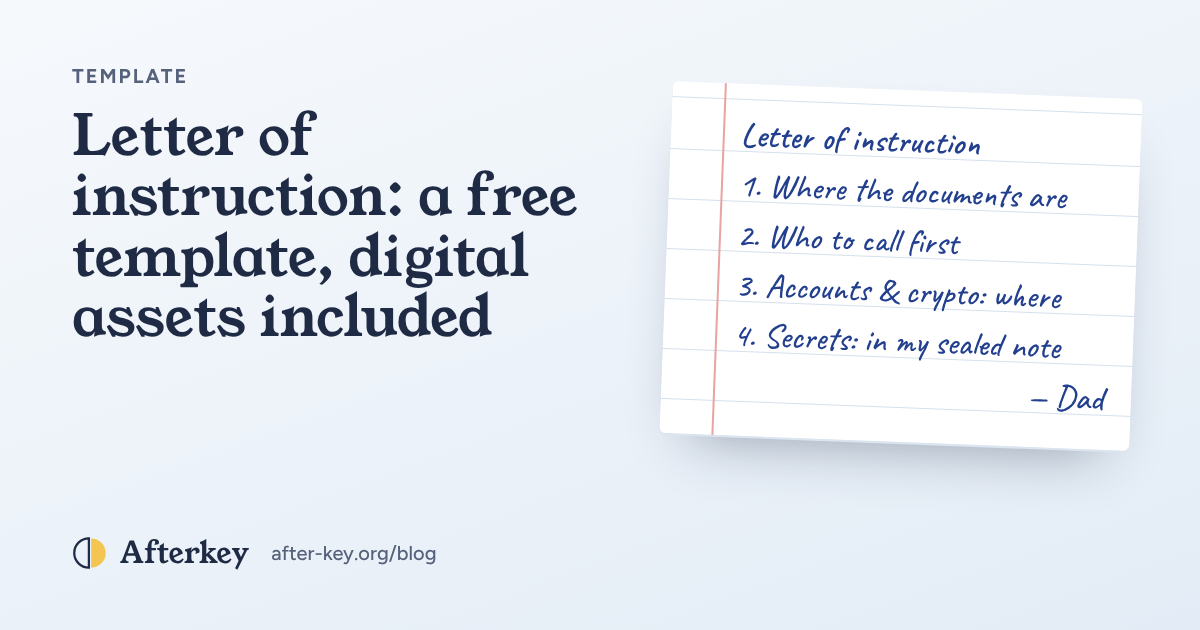
A will decides who inherits. It rarely says where a hardware wallet is, which names are on which devices, or who to call first. That practical map belongs in a letter of instruction, with the actual secrets kept in a sealed or encrypted place.
3. Most people won’t get Ripple’s help
Mellon’s estate could negotiate with the company behind his asset. If your crypto is bitcoin in a self-custody wallet, there’s no one to negotiate with. Without the seed phrase, it’s gone.
4. Plan for liquidity and taxes, not just access
Access was only the first problem. Then came a volatile asset that couldn’t be sold fast and a tax bill that arrived on schedule anyway. Write down what you’d want your executor to do: sell slowly or quickly, which exchange to use, who to call for tax advice.
5. One page would have changed a lot
Imagine the estate had found a single page like this on day one:
It wouldn’t have stopped the price crash. It would have told his family where to start.
The takeaway
Matthew Mellon’s XRP wasn’t lost forever. It took a famous family, a team of lawyers, a cooperative issuer and nearly three years to get through it, and the estate lost more than half its value along the way. Most families have none of those advantages.
The fix isn’t complicated: an inventory of where your crypto is, the secrets kept somewhere sealed, and one person who knows where to find both.
Sources
This guide is general information, not legal, tax or financial advice. Laws differ by state and country; talk to an estate planning attorney about your situation.